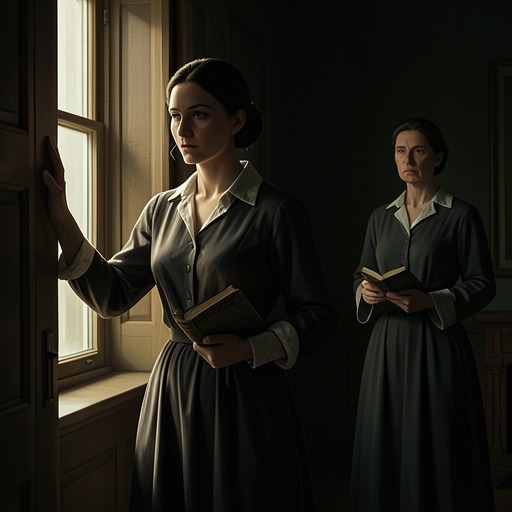
arranged marriage
My Vampire Love (Completed)The arranged marriage between Jenifer Kate Lawrence and Eric Wilson is both a personal relationship and a supernatural political instrument. Announced when Jenifer is seventeen, it links the survival of a chronically ill girl to a promise made by her parents and Eric’s family, while later revelations show that her marriage is also meant to secure her place within vampire society and preserve the power of pure-blood vampires. Its decisive tension is the conflict between freedom and attachment: Jenifer initially experiences marriage as a sentence imposed on her, but eventually separates her feelings for Eric from the coercive arrangement itself and agrees to marry him because she has fallen in love with him and wants him safe.
Origin as a Life-Saving Bargain
The arrangement is disclosed in Jenifer’s mother’s living room, where Jenifer sits opposite Eric Wilson’s parents and learns that she has been engaged to Eric since birth. Her mother explains that the agreement was made because Mr. Wilson helped Jenifer when doctors expected her to die within days. In return, he required that she marry his son at seventeen if Eric chose to do so, and his family supplied the medication that kept her alive from infancy. The arrangement therefore rests on an exchange between medical survival and future marital obligation: Jenifer was not offered an ordinary choice between romance and singleness, but between dying at birth and being married to a stranger she might hate.
The revelation produces paralysis rather than an immediate outburst. Jenifer feels blank and cold even while recognizing that she ought to be furious. Her dependence on the small brown pills makes the bargain materially inescapable. When she stops taking them, she understands that her body is beginning to shut down and imagines death as a possible escape from the pain, guilt, and heartache created by the arrangement. Later, she secretly flushes three pills down the toilet; they dissolve into a faint pinkish-red stain before she replaces the bottle and lies to Eric about being fine. Her resistance is consequently not abstract rebellion but a direct struggle over medication, bodily control, and whether continued life must be paid for with marriage.
Coercion, Freedom, and the Wedding Deadline
Eric is not initially a romantic answer to Jenifer’s objections. He is a near-stranger placed inside a contract she never consented to, and Jenifer tells him that she would rather be miserable for her entire life and remain free than be happy while trapped in a marriage she never wanted. The statement preserves a crucial distinction between happiness and autonomy: even the possibility that she and Eric might be happy together cannot, in her view, make the imposed condition acceptable. Eric recognizes the force of her resistance, yet the arrangement continues to advance around them.
The pressure becomes immediate when Eric tells her that his parents will not postpone the wedding. Invitations have already been sent, the venue has been selected, and the ceremony is set for just over a month later. The timetable turns private uncertainty into institutional momentum. Jenifer is not merely being asked to decide whether she loves Eric; she is being carried toward a public event whose preparations have already converted family expectations into social fact.
Jenifer’s relationship with the arrangement remains conflicted even after Eric proves kind and attentive. When Kris realizes that Jenifer is engaged, Jenifer feels shame—not because Eric is unworthy, but because she fears that others will believe she has forgotten Daren or never truly loved him. She describes the marriage as something she does not have a choice about, while acknowledging that Eric is sweet and kind and that another girl might feel fortunate to have him. The contradiction is central: Eric can be personally good while the institution binding them remains oppressive. Jenifer feels as though accepting him betrays Daren, whom she had expected to marry and love for life.
The Vampire Political Function
The arrangement acquires a larger purpose when Eric explains the nature of Jenifer’s body and the history of supernatural power. Pure-blood vampires awaken at eighteen, when dormant vampire blood becomes active and brings greater strength and speed. Jenifer is the only living human subject of an experiment intended to create new pure-blood vampires. Earlier subjects died, entered comas, or became made vampires or zombie-like failures when the dosage and timing of vampire blood were wrong. Her illness made the experiment possible, turning the treatment that once preserved her life into a process designed to remake her species.
Eric identifies Jenifer as both the most endangered human and the most protected one because she may become a true pure-blood vampire. He explains that vampires rule the supernatural order only because pure-bloods remain powerful; witches once held control, and power could shift again to witches, shifters, or another species. Jenifer’s awakening is therefore treated as a strategic resource rather than solely as a personal transformation. Eric tells her that this is why he must marry her before she turns eighteen: once she awakens, she will already be a vampire, and her blood may help produce stronger pure-blood descendants. The marriage connects her body to a program of species preservation, political supremacy, and future reproduction.
Katalin makes the political motive even more explicit. She wants Jenifer tied to the vampire species in every possible way: Jenifer is already a vampire and possesses the strongest bond to the Underworld, but Katalin wants her sealed to that society in the human world as well. Because pure-bloods are rare, Jenifer’s power would be wasted if it were not attached to the vampire order. The arranged marriage thus operates as a social and supernatural seal. It is meant to prevent Jenifer from standing outside the Underworld’s structures, even after her transformation makes her valuable to them.
From Refusal to Emotional Choice
Jenifer’s position changes not through a simple surrender but through a gradual revaluation of Eric. She remembers that he has been good and kind from the beginning and that her actions have already caused him pain. She also remembers that Eric once said he would call off the wedding in a heartbeat if he could, even though doing so would hurt him, because he knew the arrangement was hurting her. His willingness to release her gives the relationship a moral contrast with the family system that created it: Eric participates in the wedding’s circumstances, but he does not want her suffering to be the price of his happiness.
Even after recognizing Eric’s care, Jenifer still does not want the wedding. She is not ready to be married or to become someone’s wife, yet she decides that she will walk down the aisle and say yes for Eric because she loves him. This decision remains morally complicated. It is a gesture of devotion, but it also shows how thoroughly the original coercion has shaped the field of possible choices. Jenifer does not recover an entirely unpressured alternative; instead, she finds personal meaning inside an arrangement that began by denying her agency.
The emotional turning point arrives when Jenifer realizes that her bodily reactions to Eric are not merely guilt, gratitude, or obligation. She cannot sleep when he is absent, becomes unable to breathe properly when she does not know whether he is safe, and feels butterflies and intense nervousness around him. The recognition comes with the force of a revelation: she is in love with Eric Wilson. That discovery does not erase her earlier objections, but it changes the meaning of the wedding. What began as an imposed future now contains a relationship she actively values.
Ceremony and Aftermath
At the ceremony, Jenifer’s conflict briefly reopens. In her wedding dress, surrounded by preparations that make her look like a perfect princess or Barbie doll, she does not recognize the person reflected in the mirror. Only months earlier she had been an ordinary seventeen-year-old girl living in Trinidad with her aunt, a boyfriend, and friends; now she is a rare pure-blood vampire, engaged to someone she once barely knew, and standing before a ceremony shaped by forces far beyond the human world. The dress and the public perfection of the event emphasize the distance between appearance and inward consent.
Jenifer stops the priest in the middle of the ceremony because she needs to tell Eric the truth before they marry. With her heart pounding and her body tense from fear, she declares that she is completely in love with him and wants him to know that she does want to marry him that day. Her interruption matters because it places her own confession, rather than the family contract or the ritual script, at the emotional center of the ceremony. She attempts to speak her consent aloud before the formal words can carry her past the decision.
The marriage is completed, followed by a ten-tier white cake, a first dance as husband and wife, and the song “All My Life,” which Eric requested after hearing Jenifer sing it. The celebration is immense and widely discussed, yet Jenifer’s judgment of it is not based on its decorations, dress, or scale. Its importance lies in the person held securely in her arms and in the love she has chosen to acknowledge. The arranged marriage therefore ends in a deliberately double state: Jenifer becomes Mrs. Eric Wilson within a system that once trapped her, while her emotional acceptance gives the imposed bond a form of inward consent the original bargain could never guarantee.